TL;DR: Industrial backup generators are classified under NEC Article 700, 701, or 702, each with different required transfer times based on how critical the load is. Emergency systems must restore power within 10 seconds, legally required standby within 60 seconds, while optional standby has no fixed requirement. Sizing and classification both need to be done correctly before installation. Advanced Electric LLC designs and installs emergency power systems for Wisconsin facilities. Call (920) 921-2499.
Emergency power and backup generators for industrial facilities are not a one-size-fits-all purchase. A generator sized and installed correctly for a manufacturing plant depends on which loads absolutely cannot lose power, which loads can tolerate a short delay, and which are simply about avoiding a costly production interruption rather than a life safety concern.
An outage at a Wisconsin manufacturing facility can mean more than inconvenience. It can mean lost production, damaged work in process, spoiled materials, or, for facilities with fire alarm and life safety systems, a genuine safety gap until power is restored. The National Electrical Code addresses this directly, with separate rules depending on how critical each type of load actually is.
This guide covers the different categories of backup power systems under the electrical code, how sizing actually works, and what a facility should think through before choosing a generator.
What Are the Different Types of Backup Power Systems Under the Electrical Code?
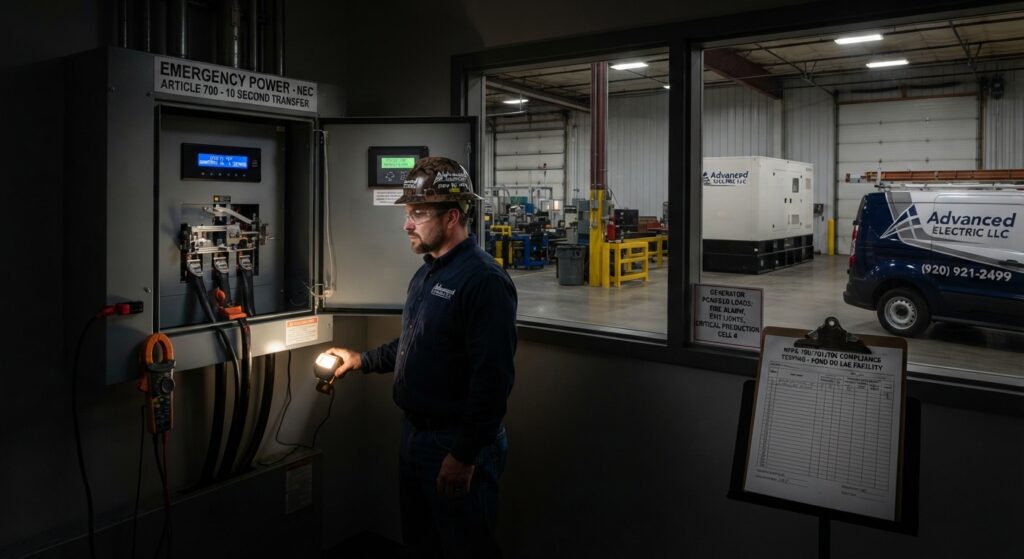
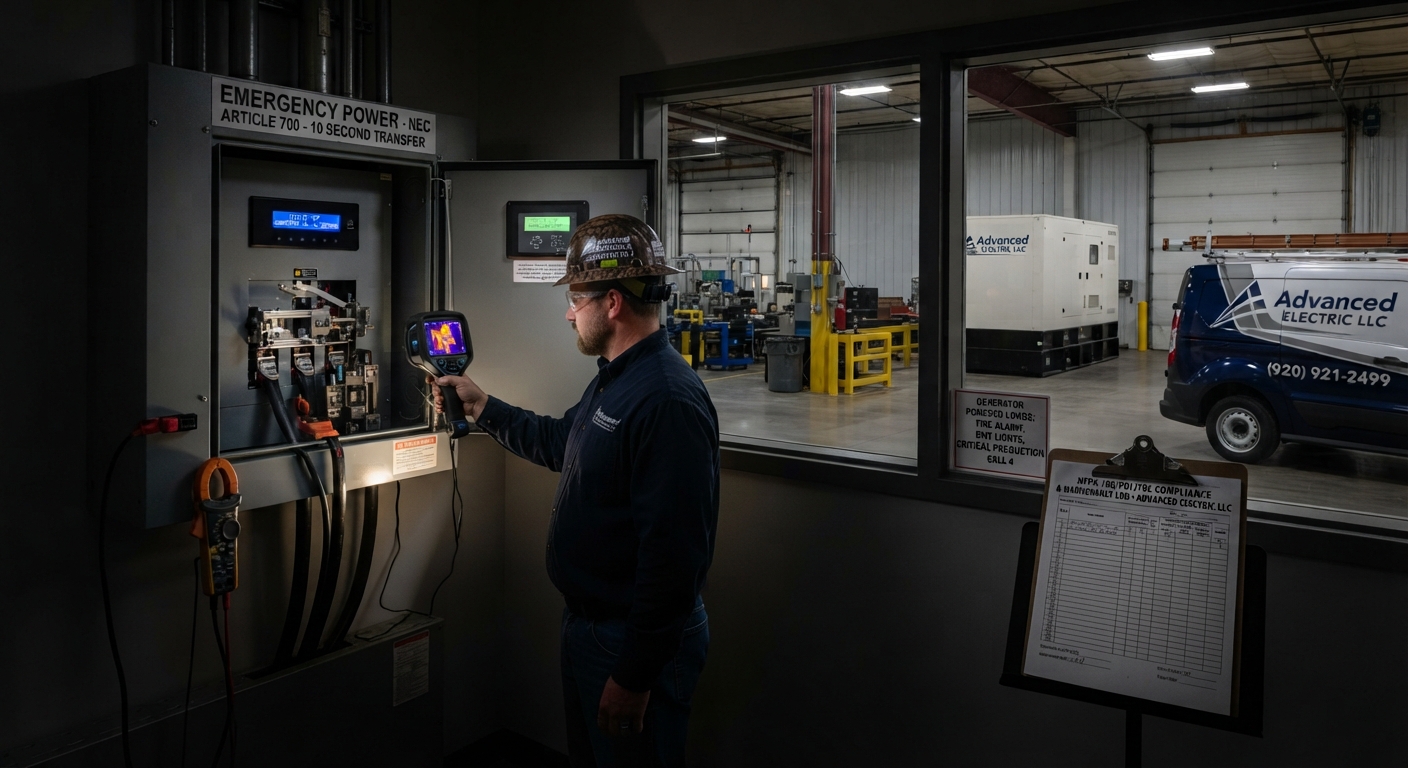
The National Electrical Code classifies backup power into three categories: Article 700 Emergency Systems, which must restore power within 10 seconds for life-safety loads like fire alarms and emergency lighting; Article 701 Legally Required Standby Systems, which must restore power within 60 seconds for loads like elevators and smoke control; and Article 702 Optional Standby Systems, which protect facilities or production without a fixed life-safety requirement.
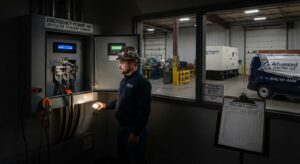
Emergency systems under Article 700 cover loads considered essential for life safety: exit signage and lighting, fire alarm and detection systems, and fire pump power. These systems are required to restore power automatically within 10 seconds of a utility outage.
Legally required standby systems under Article 701 cover loads whose failure could hamper firefighting or rescue efforts without being immediately life-critical themselves, such as elevators, smoke control systems, and communication systems for emergency responders. These allow a slightly longer restoration window of 60 seconds.
Optional standby systems under Article 702 are what most people picture when they think of a backup generator for a business: systems protecting production equipment, refrigeration, data systems, or general facility operations, where life safety is not directly at stake. These systems have no fixed transfer time requirement, giving more flexibility in how they are designed.
Why the Classification Matters for Your Facility
Getting the classification right is not a paperwork formality. It determines the transfer switch equipment required, the wiring methods used, and how the system is inspected and approved. A facility with fire alarm and emergency lighting loads mixed into the same circuit as general production equipment, without proper separation, can end up out of compliance even with a generator installed and running.
Most industrial facilities in Wisconsin end up needing a combination: an emergency or legally required standby system sized specifically for life-safety and code-required loads, plus a separate optional standby system, or a larger combined system with proper load segregation, for production and general facility needs.
This is where working with an electrical contractor experienced in industrial and commercial generator installations matters. Getting the classification wrong at the design stage creates problems that are expensive to correct after installation.
How Do I Size a Generator for My Facility?
Generator sizing starts with a load calculation covering every circuit the generator needs to support, including the startup surge of any large motors, not just their steady running current. An undersized generator can fail to start critical equipment, while an oversized one adds unnecessary cost.
Motor startup current is one of the most commonly underestimated factors in generator sizing. A motor can draw several times its running current for a brief moment during startup, and a generator that is not sized to handle that surge, especially when multiple motors might start close together, can stall or fail to bring the load online.
This is another reason a proper load calculation, done by someone familiar with industrial equipment specifically, produces a more reliable result than a generic sizing chart based on square footage or general facility type.
Fuel type and run-time expectations also factor into sizing. A facility that only needs to bridge a short utility outage has different requirements than one that needs to run production for an extended stretch, and that distinction affects both the generator’s size and the fuel supply arrangement behind it.
What Does a Transfer Switch Actually Do?
A transfer switch automatically or manually switches a facility’s electrical load from utility power to generator power during an outage, and back again once utility power is restored. The type and speed of transfer switch required depends on the load classification under NEC 700, 701, or 702.
An automatic transfer switch is required for emergency systems under Article 700, given the 10-second restoration requirement, since a manual switch could never reliably meet that timeline. Legally required and optional standby systems have more flexibility, though automatic transfer switches are common across all three categories for practical reasons, not just where strictly required.
What Happens During a Power Outage Without a Backup System
Without emergency or standby power, a Wisconsin manufacturing facility loses everything tied to that circuit the moment utility power drops: production equipment, refrigeration, computer systems, and, critically, any fire alarm or emergency lighting systems not otherwise protected by battery backup.
For facilities running temperature-sensitive processes or materials, even a short outage can mean spoiled product or a costly restart of a production process. For facilities with any occupied space, a fire alarm system without emergency power is a genuine gap until it is restored, not just an inconvenience.
The cost comparison almost always favors planning ahead. A properly sized backup system is a known, budgeted cost. An unplanned outage’s cost, in lost production, spoiled materials, or a safety gap, is unpredictable and often larger than the system that would have prevented it.
Does Advanced Electric LLC Design and Install Industrial Generator Systems?
Yes. Advanced Electric LLC designs and installs emergency, legally required standby, and optional standby power systems for industrial and manufacturing facilities across Wisconsin, including load calculations, transfer switch installation, and proper code classification for each system.
We work with facility managers from the planning stage through installation, making sure life-safety loads are properly classified and protected while also addressing the production and operational continuity concerns that drive most industrial generator projects.
That includes coordinating the permit and inspection process, which for commercial and industrial generator installations typically involves both the local municipality and, depending on system size and fuel type, additional review beyond what a typical electrical permit requires.
Plan Your Facility’s Backup Generators Power
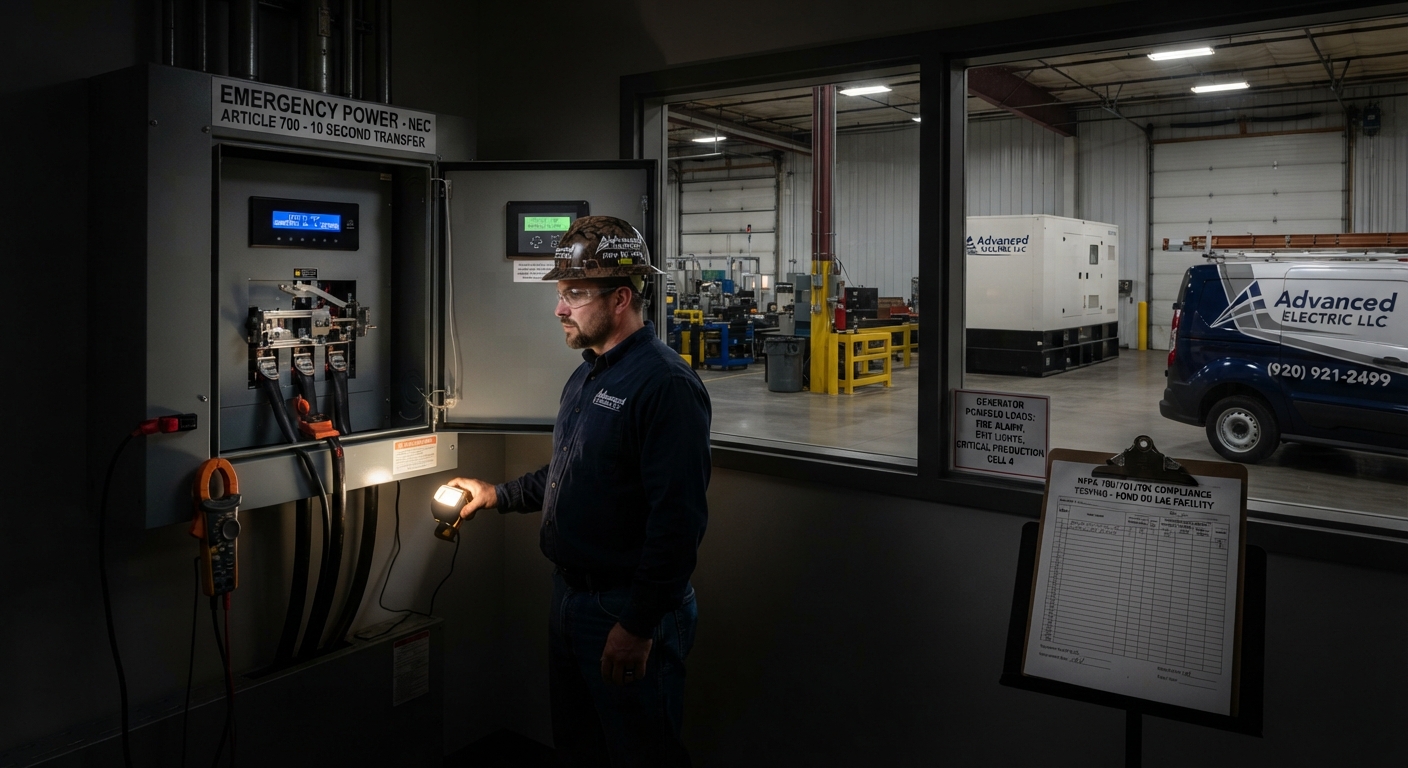
Backup power for an industrial facility is not just about buying a generator large enough to run the building. It is about correctly classifying which loads are life-safety critical, which are code-required standby, and which are about protecting production, then designing and sizing the system to match.
Advanced Electric LLC has designed and installed emergency power solutions for industrial and manufacturing clients across Fond du Lac and Wisconsin since 1998, with over 60 years of combined team experience.
Call (920) 921-2499 or request a free site assessment to plan backup power for your facility before the next outage forces the issue.
Frequently Asked Questions
What is the difference between an emergency system and a standby system under the electrical code?
Emergency systems under NEC Article 700 must restore power within 10 seconds for life-safety loads like fire alarms and exit lighting. Legally required standby systems under Article 701 allow 60 seconds for loads like elevators and smoke control. Optional standby systems under Article 702 have no fixed transfer time and typically cover production or general facility loads.
How do I know how large a generator my facility needs?
A load calculation performed by an electrician familiar with industrial equipment accounts for both steady running current and motor startup surge across every circuit the generator needs to support, which is the only reliable way to size a system correctly.
Does my facility need an automatic transfer switch?
Emergency systems under Article 700 require automatic transfer switches due to the 10-second restoration requirement. Many facilities choose automatic transfer switches for standby systems as well, for reliability, even where not strictly required by code.
Can Advanced Electric LLC handle the permit and inspection process for a generator installation?
Yes. We handle permitting and inspection coordination as part of every generator installation project, working with the applicable municipality and any required commercial or industrial code review.
What Wisconsin areas does Advanced Electric LLC serve for industrial generator installation?
We serve manufacturing and industrial clients in Fond du Lac, Milwaukee, Madison, Oshkosh, and the surrounding Wisconsin communities.
Advanced Electric LLC has served Fond du Lac and surrounding Wisconsin communities since 1998, with over 60 years of combined team experience and a safety-first, Clean Wiring approach on every job.
Call (920) 921-2499 or request a free estimate today.
213 W 9th St, Fond du Lac, WI 54936 | Mon through Fri, 9:00 AM to 3:00 PM