TL;DR: Hiring an industrial electrician in Wisconsin means checking for the right license category, real experience with plant environments, and a contractor who understands three-phase systems, motor connections, and code compliance for manufacturing facilities. Not every residential or commercial electrician takes on industrial work. Advanced Electric LLC has served industrial clients across Wisconsin since 1998. Call (920) 921-2499.
Industrial electrician Wisconsin is not the same search as electrician Fond du Lac. A plant manager or facilities director looking for industrial electrical help usually has a narrower, higher-stakes problem: a production line that cannot go down, a panel that was never sized for the equipment now running on it, or a new piece of machinery that needs a three-phase connection done right the first time.
Most electrical contractors in Wisconsin focus on homes and small commercial buildings. Industrial work is a different discipline, with different code sections, different equipment, and a much lower tolerance for downtime. Hiring the wrong contractor for an industrial job does not just risk a bad outlet. It risks a production stoppage, a failed inspection, or a safety incident on a factory floor.
This guide covers what actually separates an industrial-capable electrical contractor from a general one, what licensing means in Wisconsin specifically, and the questions worth asking before you sign a contract.
What Makes Industrial Electrical Work Different?
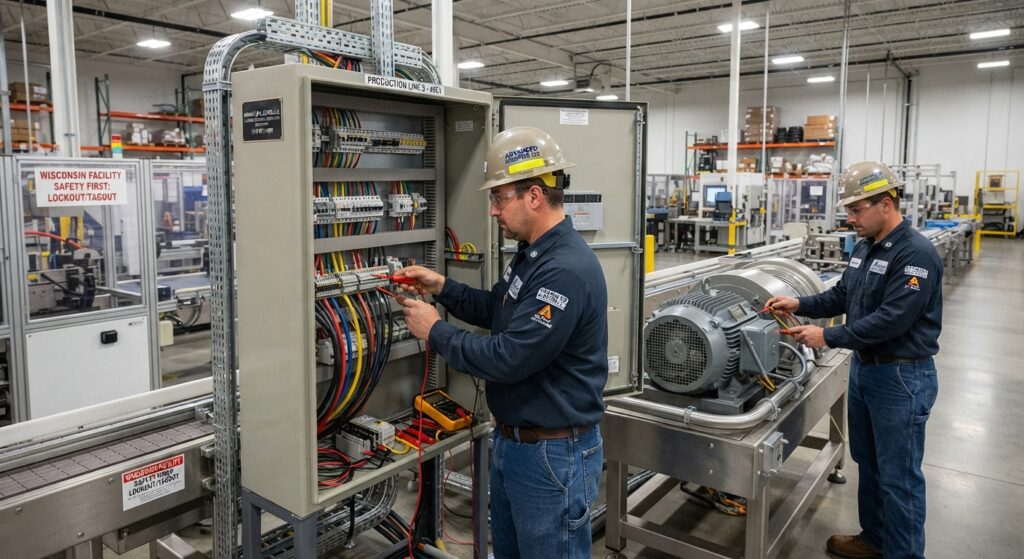
Industrial electrical work involves higher voltage systems, three-phase power, motor controls, and equipment connections that residential and light commercial electricians rarely encounter. It also demands a working knowledge of plant safety protocols like lockout/tagout, since mistakes on a production floor carry higher consequences than in a home or office.
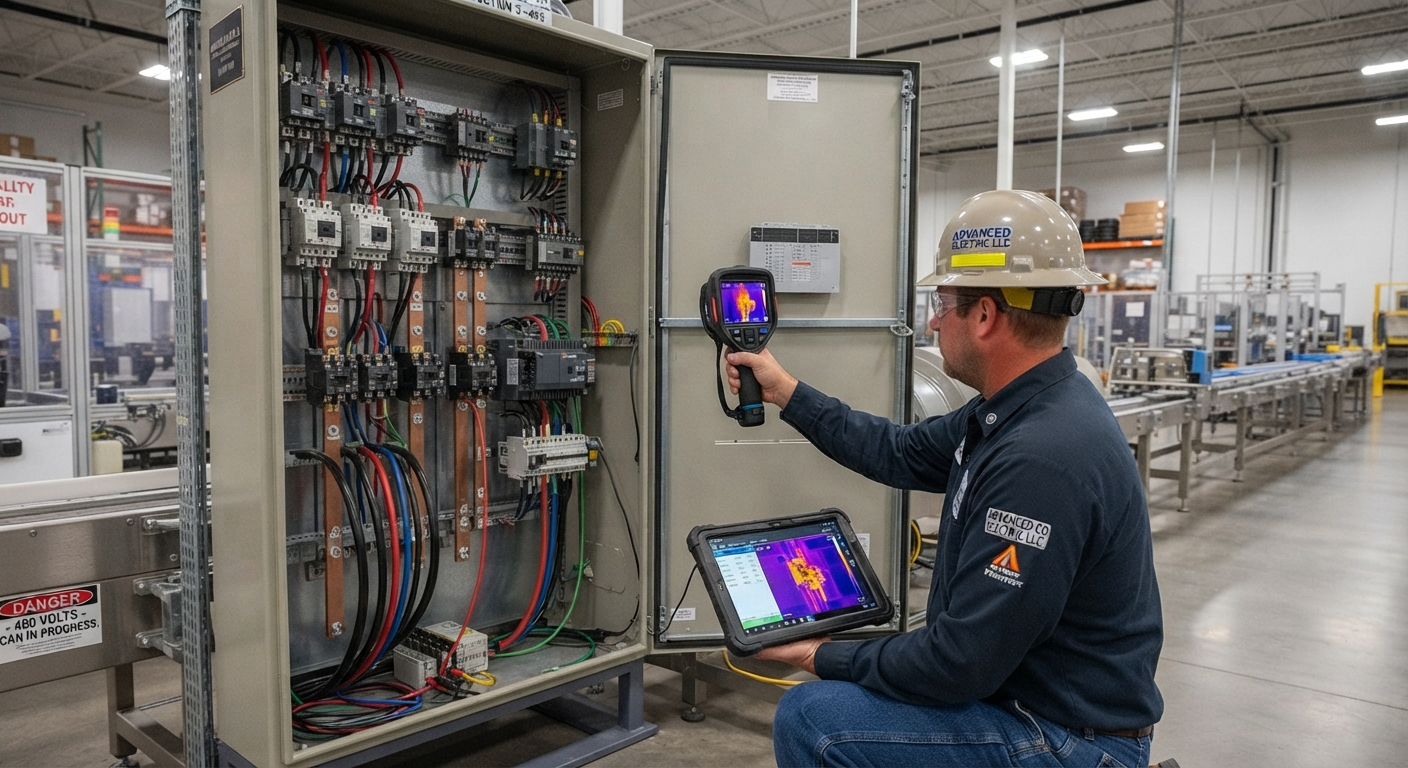
A residential electrician spends most of a career working with 120 and 240 volt single-phase circuits. An industrial electrician works with three-phase systems running at 208, 480, or even higher voltages, powering motors, conveyors, compressors, and production equipment that draw far more current than anything in a house.
The safety stakes are different too. OSHA’s electrical standards for general industry, found in 29 CFR 1910 Subpart S, apply specifically to workplaces like manufacturing plants, alongside the National Fire Protection Association’s NFPA 70E standard for electrical safety in the workplace (per OSHA’s electrical standards page). A contractor who only works on homes may not have day-to-day familiarity with those requirements.
Is an Industrial Electrician License the Same as a Regular Journeyman License?
No. Wisconsin’s Industrial Journeyman Electrician license is actually more restricted than a general Journeyman Electrician license, not less. It only allows the license holder to perform electrical wiring within the facility of the specific business that employs them, not for outside clients.
This is a detail worth understanding before you hire. Wisconsin’s Department of Safety and Professional Services requires an Industrial Journeyman Electrician applicant to complete at least 1,000 hours per year of industrial electrical wiring experience for five years, or an approved industrial apprenticeship, before testing for the license (per Wisconsin DSPS’s Industrial Journeyman Electrician application). But that license is scoped to work inside the license holder’s own employer’s facility.
In practical terms, this means the in-house maintenance electrician at a manufacturing plant may hold an Industrial Journeyman license, but an outside contractor coming in to do industrial work for that plant needs a Wisconsin Electrical Contractor license along with properly licensed Master and Journeyman Electricians on staff, the same core credentials used for commercial and residential contracting, applied to industrial-scale work. Advanced Electric LLC operates under this contractor licensing structure, which is what allows us to legally perform industrial electrical work for clients across Wisconsin rather than being limited to a single employer’s facility.
Six Questions to Ask Before Hiring an Industrial Electrical Contractor
Have you worked in manufacturing or industrial facilities before? Ask for specific examples, not just a general “yes.” Motor connections, three-phase panel work, and production-line equipment tie-ins require hands-on experience that residential work does not provide.
Are you licensed as a Wisconsin Electrical Contractor, with Master and Journeyman Electricians on staff? This is the credential that actually allows a contractor to perform industrial work for outside clients, as opposed to the facility-restricted Industrial Journeyman license described above.
Do you carry adequate liability and workers’ compensation insurance for industrial job sites? Plant environments carry different risk profiles than a residential job. A contractor should be able to provide proof of coverage without hesitation.
How do you handle work around active production lines? A contractor experienced with industrial clients will have a clear answer about scheduling around production, coordinating shutdowns, and minimizing downtime, not just a promise to “work around you.”
Can you provide references from other commercial or industrial clients? Named project references, not just star ratings, tell you far more about how a contractor actually performs on larger jobs.
Do you understand lockout/tagout and plant safety protocols? A contractor working near live equipment and production machinery should be fluent in these procedures, not learning them on your site.
What Industrial Electrical Services Should a Capable Contractor Offer?
A full-service industrial electrical contractor should offer three-phase wiring and motor connections, industrial panel upgrades, electrical layout and design for new equipment, fire alarm and life safety systems, data and security infrastructure, and emergency power solutions. A contractor limited to basic repairs is not equipped for a full plant relationship.
Industrial clients are usually better served by a contractor who can handle the full range of a facility’s electrical needs over time, not just a single emergency call. That includes planning ahead for equipment additions, keeping documentation current, and understanding how a facility’s electrical system evolves as production changes.
Advanced Electric LLC offers the full range of industrial electrical services across Wisconsin, including three-phase wiring, motor connections, panel upgrades, fire alarm systems, data cabling, security systems, and emergency power, all under the same safety-first, Clean Wiring standard we apply to residential and commercial work.
The Cost of Getting This Wrong
Hiring a contractor without real industrial experience is not just a quality risk. A poorly executed three-phase connection or an undersized panel can cause equipment damage, unplanned downtime, or a failed inspection that delays a production line from coming back online.
Downtime is often the most expensive part of a mistake. A production line that goes down because of an electrical issue costs far more per hour than the original electrical work would have cost to do correctly. This is part of why experience with plant environments specifically, not just electrical work in general, matters so much for this category of hiring decision.
It is also why documentation matters. A contractor who leaves a facility’s electrical team with clear, labeled panel work and accurate records makes every future service call faster and cheaper, while a contractor who leaves behind a mess creates hidden costs for years afterward.
Does Advanced Electric LLC Serve Industrial Clients Outside Fond du Lac?
Yes. Advanced Electric LLC serves industrial clients across Fond du Lac, Milwaukee, Madison, Oshkosh, and the surrounding Wisconsin communities, bringing the same safety-first, Clean Wiring standard to plant and manufacturing facility work as we do to residential and commercial jobs.
Industrial capability is one of the clearer differentiators between a general local electrician and a contractor built to handle plant-scale work. Most small electrical contractors do not serve industrial clients at all, which means facility managers evaluating options in Wisconsin often have fewer genuinely qualified choices than they expect.
Talk to an Industrial Electrical Contractor You Can Trust
Hiring the right industrial electrical contractor comes down to real experience, the correct licensing structure, and a track record with plant-scale work, not just a general electrician’s license and a willingness to take the job.
Advanced Electric LLC has served residential, commercial, and industrial clients across Fond du Lac and Wisconsin since 1998, with over 60 years of combined team experience and a safety-first approach built for facility environments.
Call (920) 921-2499 or request a free industrial site assessment to talk through your facility’s electrical needs.

Frequently Asked Questions
What license does an outside contractor need to do industrial electrical work in Wisconsin?
An outside contractor needs a Wisconsin Electrical Contractor license and properly licensed Master and Journeyman Electricians on staff. Wisconsin’s Industrial Journeyman Electrician license, by contrast, only permits work within the license holder’s own employer’s facility.
How is industrial electrical work different from commercial electrical work?
Industrial work typically involves higher voltage three-phase systems, motor connections, and production equipment tie-ins, while commercial work more often covers office buildings, retail spaces, and lighting systems. Industrial jobs also carry more plant-safety considerations, like lockout/tagout procedures.
Can Advanced Electric LLC work around an active production schedule?
Yes. We coordinate scheduling with facility managers to minimize downtime, including work planned around shift changes or planned maintenance windows when that fits a client’s production needs.
Does Advanced Electric LLC handle both new equipment installation and repairs for industrial clients?
Yes. We handle new equipment connections, panel upgrades, electrical layout and design, and ongoing troubleshooting and repair work for industrial and manufacturing facilities.
What Wisconsin markets does Advanced Electric LLC serve for industrial work?
We serve industrial clients in Fond du Lac, Milwaukee, Madison, Oshkosh, and the surrounding Wisconsin communities, with dedicated experience across all three of our service verticals in each market.
Advanced Electric LLC has served Fond du Lac and surrounding Wisconsin communities since 1998, with over 60 years of combined team experience and a safety-first, Clean Wiring approach on every job.
Call (920) 921-2499 or request a free estimate today.
213 W 9th St, Fond du Lac, WI 54936 | Mon through Fri, 9:00 AM to 3:00 PM
Related reading: Learn more about becoming an electrician in Wisconsin and what industrial electricians do.