TL;DR: Emergency lighting requirements say your exit path must stay lit for at least 90 minutes when power fails. Exit signs must stay lit and easy to read. The Life Safety Code calls for a 30 second test every month and a 90 minute test every year. You also need written records. For testing, repairs or new units, call Advanced Electric LLC at (920) 921-2499.
When the power drops in a busy store or restaurant, people need to see the way out. That is the whole point of emergency lighting requirements. They keep your exits lit and your exit signs visible until everyone is outside.
This matters more than most owners think. The U.S. Fire Administration counted 16,500 office and store fires in 2020, with $932 million in direct property damage. Fire is not the only threat here in Wisconsin. A winter storm can knock out power across Fond du Lac. Your customers could be left standing in the dark.
The good news is that the rules are clear. Your lights need to come on by themselves, stay on long enough and pass regular tests. You also need paperwork to prove it.
This guide covers what the codes ask for and which buildings need it. It also explains testing and what inspectors flag most. Advanced Electric LLC has handled commercial electrical work for Fond du Lac businesses since 1998.
What Are the Emergency Lighting Requirements for Businesses?
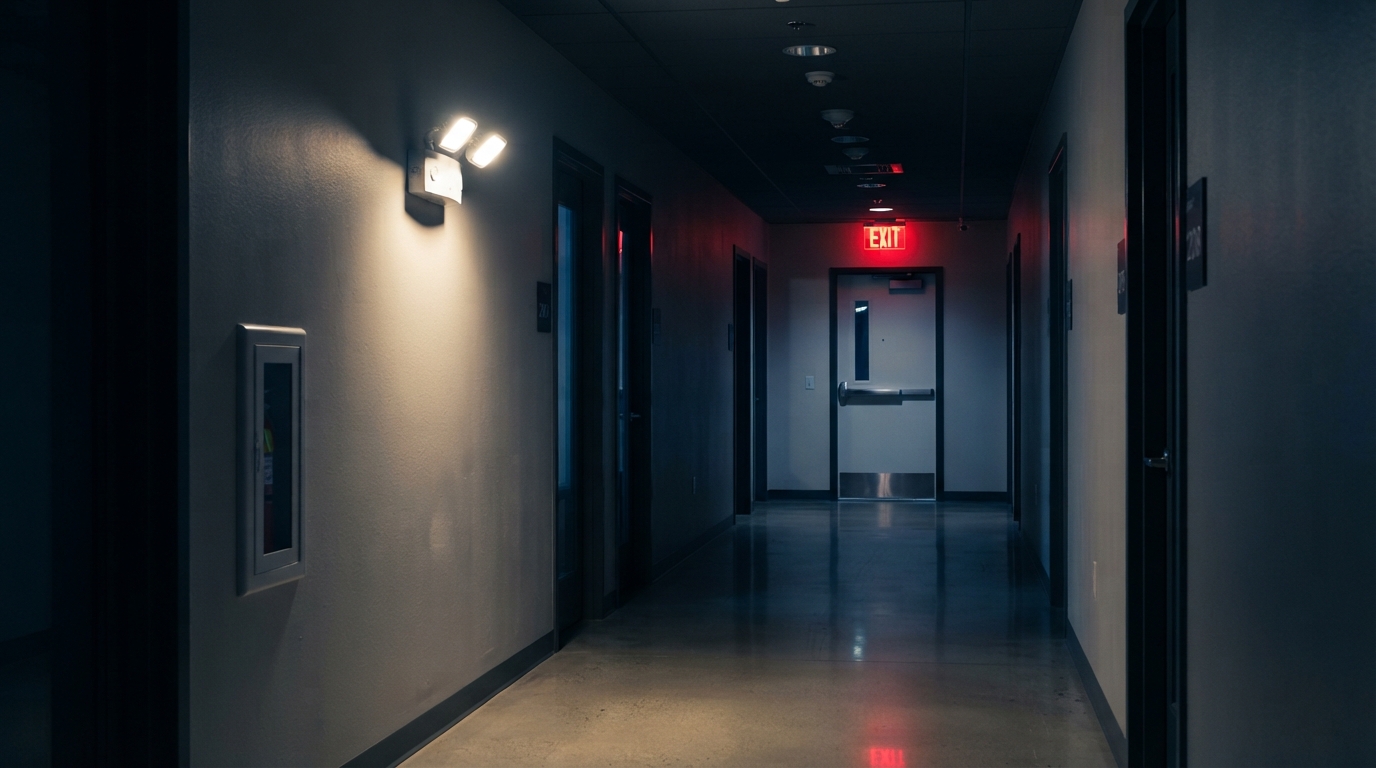
Emergency lighting must turn on by itself when normal power fails. It must light the path to the exits for at least 90 minutes. Exit signs must stay lit and easy to read. The system needs monthly and yearly tests, with written records of each one.
The main rule book is NFPA 101, the Life Safety Code. A manufacturer’s code summary says it calls for at least 1½ hours of emergency light. The code also sets minimum light levels along the exit path, measured at the floor. Those levels must hold for the full 90 minutes.
The switch to backup power must also be quick. Transfer has to be automatic and happen within 10 seconds of losing normal power.
OSHA adds its own workplace rules. Under 29 CFR 1910.37, workers must be able to see along every exit route. Each exit sign must be lit to at least five foot candles. The word “Exit” must be at least six inches tall.
Which Buildings Need Commercial Emergency Lighting?
Most businesses that serve the public or have employees need emergency lighting and lit exit signs. The exact rules depend on how the building is used, its size and its layout. Your local fire inspector decides how the code applies to your space.
Wisconsin’s commercial building program covers public buildings, places of employment and multifamily buildings. That takes in shops, offices, restaurants and plants. If people work or shop there, plan on exit lighting.
OSHA’s exit rules apply to nearly every workplace. Under 29 CFR 1910.36, most workplaces need at least two exit routes. Workers must be able to open exit doors from the inside without a key or tool.
Larger sites often need more than wall units and signs. Our commercial electrical services cover that bigger work.
How Often Do You Have to Test Emergency Lights?
NFPA 101 calls for a functional test of at least 30 seconds every month. Tests fall 3 to 5 weeks apart. Once a year, the system must run a full 90 minutes. You must keep written records of every test for the fire inspector to review.
A Minnesota Department of Health guide spells out these Life Safety Code testing rules. Lights may dim a bit during the long test. They still have to meet the minimum levels for the full 90 minutes.
Some units test themselves. The same guide says these units must test and check themselves at least every 30 days. They still need a monthly visual check and the yearly 90 minute test.
Here is a tip that catches many owners. The small test button on a unit mostly checks the lamps, says Minnesota’s State Fire Marshal. It does not prove the battery will last. The long test needs a proper setup, and that is a job for an electrician.
Battery Units vs Generator Backed Systems
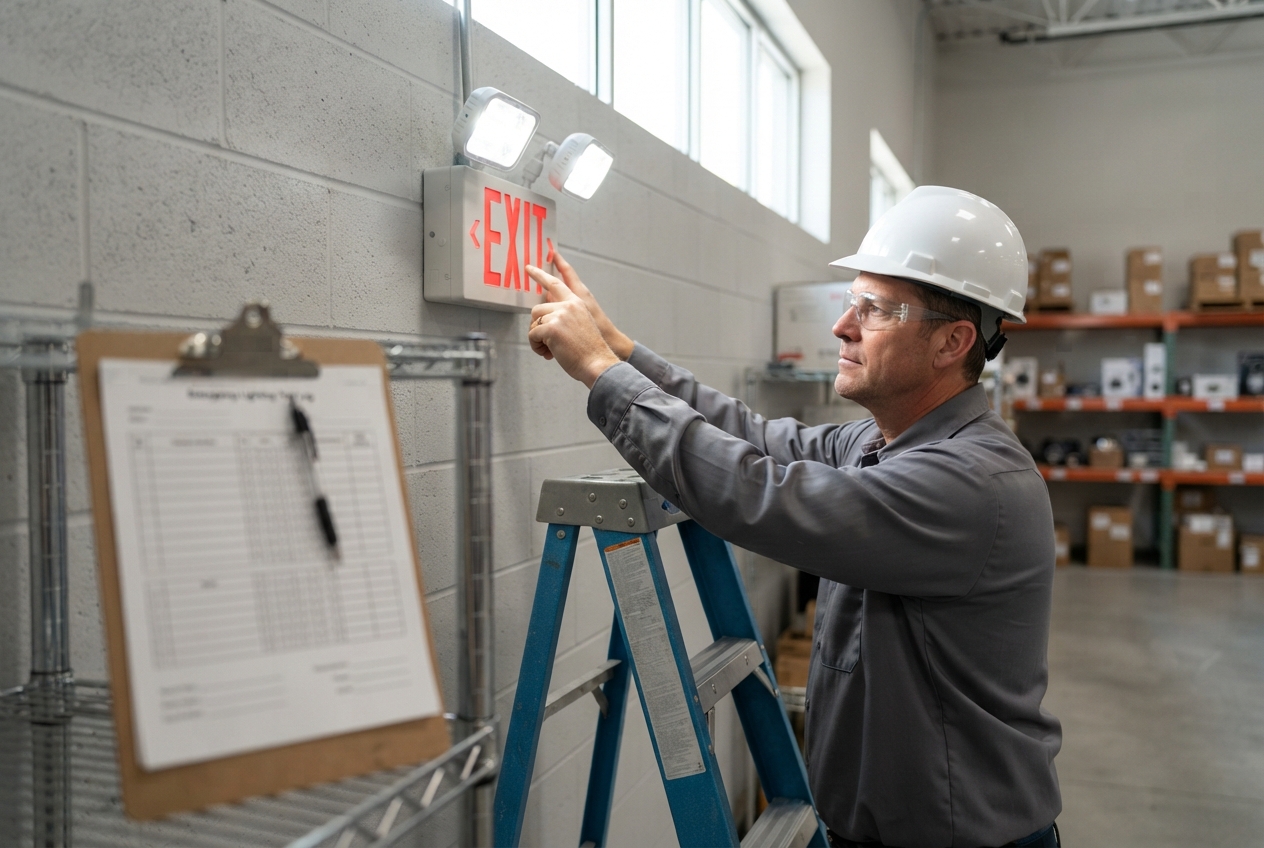
Many small and midsize businesses use battery units. These are the familiar wall fixtures with two lamp heads, plus exit signs with a battery inside. Each one charges from the building circuit and turns on by itself when power drops.
Battery units are simple, but batteries wear out. A sealed lead acid battery may last somewhere between 5 and 10 years. Service life also varies with conditions such as temperature.
One maker’s instructions say to allow 24 hours of charging before testing a new unit. The same guide lists blink codes for a bad battery or a charger fault. If a light is blinking at you, it is telling you something.
Larger buildings may run exit lights from a generator or central inverter. These systems fall under Article 700 of the National Electrical Code. Wisconsin moved to the 2023 National Electrical Code on September 1, 2026. That design work belongs with a licensed electrician.
What Do Inspectors Find Most Often?
Fire inspectors often find dark or damaged exit signs and emergency lights that do not work. Blocked exits and missing test logs are common too. Most of these problems trace back to dead batteries, burned out lamps or storage piled in front of exits.
Fire departments publish lists of the violations they see again and again. Woodbury, Minnesota puts exit signs that are not lit near the top. Its list also names broken emergency lighting and blocked exits.
OSHA is firm on clear paths. Its rule says no materials or equipment may sit in an exit route, even for a short time. A stack of boxes can hide an exit sign completely.
Common failures in shops, restaurants and offices include:
- Batteries that no longer last 90 minutes
- Burned out lamps or dead LED heads
- Exit signs that are dark, broken or hidden
- Units that lost power and never got fixed
- A missing test log, or one with months skipped
Regular checks catch these early. A business electrical maintenance plan can include your emergency lights.
Who Enforces Emergency Lighting Code Requirements in Wisconsin
Your local fire department does most of the checking. Under the state fire dues program, the fire chief must provide for inspecting every public building and place of employment at least once in each six month period. State rules allow some exceptions.
The state Department of Safety and Professional Services runs the commercial building code. DSPS has published code inserts for the 2021 International Building Code. Plan review is required for many larger commercial buildings, so new builds get checked early.
Electrical work on these systems may need a permit. Our guide to Wisconsin electrical permits explains when.
Keep a simple log with the date, unit location, test length, result and tester. Minnesota’s fire marshal advises keeping logs for at least three years. Make sure two people know where the log lives.
When to Call a Licensed Commercial Electrician
Staff can handle the simple monthly check. Press each test button, watch the unit and write down what you see. Anything inside a fixture, a panel or a junction box is work for a licensed electrician.
Call a licensed electrician if you notice any of these warning signs:
A light stays dark when you press the test button. A unit dies before the 90 minute test ends. A fixture shows a fault light. An exit sign is dim or flickering. Your inspector wrote up your emergency lighting. You are remodeling or adding rooms.
New units must connect to the circuit that serves the normal lighting in that area. The Minnesota State Fire Marshal notes they must tie in ahead of any local switch. Getting that wrong can leave a hallway dark when it matters most.
If your building has a fire alarm system, plan both together. Read about fire alarms for manufacturing facilities in Wisconsin. Local owners can also see our commercial electrical work in Fond du Lac.
Emergency Lighting Requirements FAQ
How long do emergency lights have to stay on?
The Life Safety Code calls for at least 90 minutes of emergency light after normal power fails. Light levels may fade a little during that time. They must still meet the minimum levels along the exit path until the end.
How bright do exit signs need to be?
OSHA says each exit sign must be lit to at least five foot candles on its surface. The word “Exit” must be at least six inches tall in clear letters.
Can my staff do the monthly emergency light test?
Yes, staff can press the test button, watch each unit for 30 seconds and log the result. The test button alone may not prove the battery can last. Leave the yearly 90 minute test and any repairs to a licensed electrician.
How long do emergency light batteries last?
The Minnesota State Fire Marshal says a sealed lead acid battery may last about 5 to 10 years. Temperature and age both affect that life. If a unit fails its 90 minute test, the battery is often the first suspect.
What records do I need to keep for emergency lighting?
The Life Safety Code requires written records of your monthly and yearly tests. Note the date, the unit, the test length, the result and the tester. Keep the log where your fire inspector can see it.
Call Advanced Electric LLC for a Free Estimate
Dark exit signs and dead backup lights are easy to miss until the power goes out. We test, repair and replace emergency lighting for businesses across Fond du Lac and nearby Wisconsin communities.
Our team brings over 60 years of combined experience and a Clean Wiring approach to every job. We will check your units, fix what fails and help you keep a clean test record.
Call (920) 921-2499 or request a free estimate today.
213 W 9th St, Fond du Lac, WI 54935 | Mon through Fri, 7:00 AM to 4:00 PM